Philippines
is a sovereign country located in the southeast Asia on the western pacific
ocean. It is an archipelago consisting of 7107 islands which its capital is
Manila and it is divided in Luzon, Visayas and Mindanao. The official languages
of this country are Filipino (National Language) and English.
Philippines
has a population of more than 92 million people and its considered the 12th
most populated country in the world and the 7th most populated
country in Asia.
The
Philippines’ culture is a combination of Eastern and Western countries. Its
culture came from the Asian countries with a Malay heritage and also it has
influences from the Spanish and the Americans. To be more specific we could
talk about the culture in areas of Language, Religion and Cuisine.

First
of all, the Philippines language is a very broad topic so it is divided in
three parts, National and official, indigenous and major foreign languages. For
three centuries Spanish had been the official language, but in 1901 English
became the official language and in 1973 the constitution declared Filipino as
an official language too. Nowadays, Filipino and English are considered the
official language of Philippines and Filipino as the National language. Another
type of language is the Indigenous; in this family are around 171 languages
that belong to the Malayo-Polinesian. Within the 171 languages are 13 languages
that are spoken for more de one million people, these languages are Tagalog,
Cebuano, Ilokano, Hiligaynon, Waray-Waray, Kapampangan, Bikol, Albay Bikol,
Pangasinan, Maranao, Maguindanao, Kinaray-a, and Tausug. In the last part we
have the Major Foreign Languages; in here we have English, which was introduced
in 1762; Spanish, which was introduced in 1565; Chinese/Lan-nang, in the early
10th century; Arabic, which is used for some Muslim population since
the 14th century; Japanese, that came at the 11th
century; and Bahasa Melayu/Bahasa Indonesia,that is spoken in the southernmost
parts of the Philippines.
A
second aspect of the Philippines’ Culture is the Religion. In this country the
Religion and the State are separated, however, most of the population of the
country is Religious, like 90% are Christians and the 10% are Muslims. This is
one of the countries that has more Christian people in Asia. Within the 90% of
Christians are 80% that are Catholics and the rest 10% are from other religious
communities like the Jehova’s witnesses.
Another
important aspect of the Philippines culture is the Cuisine. In this country are
many kinds of cuisine, the Malay, Indian, Arab, Chinese, Spanish, Japanese,
American and South American Cuisines. As we can see in Philippines are a lot of
different kinds of food, and according to Wikipedia these are some of the most
common dishes:
·
Congee( Arroz Caldo), it’s a very popular
dish in Asian countries, it’s a kind of rice porridge and it’s usually served
alone, but sometimes they add strips of fresh ginger or other sides.
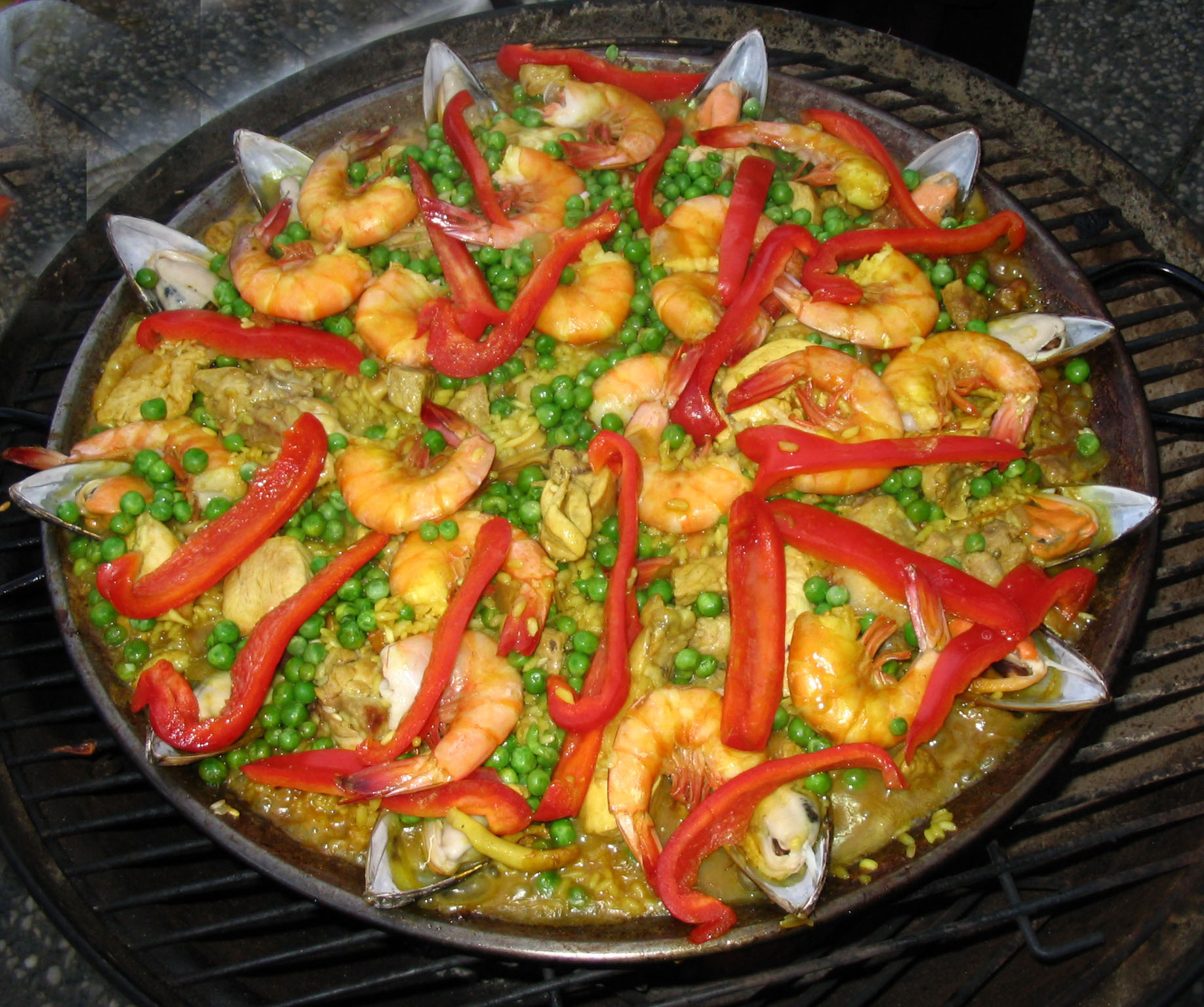
· Paella, it’s most created for “fiestas”, it
is origin from Valencia, Spain; it contains beans, White rice, type of meat(meat,
seafood, mixed),vegetables and land snails.
 ·
Chop suey, it’s from Chinese cuisine, it
consists of meat and eggs cooked with vegetables.
·
Chop suey, it’s from Chinese cuisine, it
consists of meat and eggs cooked with vegetables.
·
Puto, it is a steamed rice cake that is
commonly eaten for breakfast with butter.
·
Korma, it is originated from Central and
South Asia; it is made with yogurt, cream, nut and coconut milk.
 ·
Lechon, is an adult pig that it is served in
the center of the table.
·
Lechon, is an adult pig that it is served in
the center of the table.
·
Champorado, sweet rice porridge flavored with
chocolate, served at breakfast with "tuyo" (salted dried herring) or
"daing" (milk fish).
·
Adobo, it consists of pork or chicken,
sometimes both, stewed or braised in a sauce made from vinegar, cooking oil,
garlic, bay leaf, peppercorns, and soy sauce.
·
Sinigang, fish prepared with vegetables and a
souring agent or roasted over hot charcoal or wood.
The
dishes mentioned above are some of the most important dishes; however, the
Philippine cuisine is very broad so there are a lot of other dishes that are
important like, the noodles, dinengdeng, Goto, Crispy pata, Kare-kare, lechon,
chicharron, “tapsilog”, “puto”, among others.
Although
Philippine cuisine has many influences from around the world it also has two
unique features, the first one it is that they combine the sweet, sour, and
salty flavors; and the second one is that they serve everything in a main
course not in different courses.
Chop Suey.
(2012, June 24). Retrieved from Wikipedia The Free Encyclopedia:
http://en.wikipedia.org/wiki/Chop_suey
Congee.
(2012, June 19). Retrieved from Wikipedia The Free Encyclopedia:
http://en.wikipedia.org/wiki/Lugaw#Filipino
Korma.
(2012, June 15). Retrieved from Wikipedia The Free Encyclopedia:
http://en.wikipedia.org/wiki/Korma
Paella.
(2012, June 10). Retrieved from Wikipedia The Free Encyclopedia:
http://en.wikipedia.org/wiki/Paella
Philippine Cuisine. (2012, June 26). Retrieved from Wikipedia The Free Encyclopedia:
http://en.wikipedia.org/wiki/Philippine_cuisine
Philippines.
(2012, June 27). Retrieved from Wikipedia The Free Encyclopedia:
http://en.wikipedia.org/wiki/Philippines
Puto. (2012,
June 12). Retrieved from Wikipedia The Free Encyclopedia:
http://en.wikipedia.org/wiki/Puto


 ·
Chop suey, it’s from Chinese cuisine, it
consists of meat and eggs cooked with vegetables.
·
Chop suey, it’s from Chinese cuisine, it
consists of meat and eggs cooked with vegetables.
 ·
Lechon, is an adult pig that it is served in
the center of the table.
·
Lechon, is an adult pig that it is served in
the center of the table.


